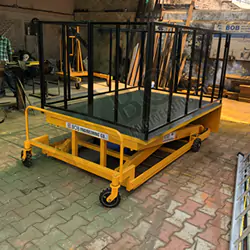
In modern industrial and commercial areas, equipment for handling materials plays an important role in enhancing efficiency and security. Companies depend on modern lifting systems to minimize manual work and improve productivity. The most popular lifting solutions is use the hydraulic scissor lift or hydraulic goods lift.
Hydraulic technology is use in both lifts but for very different purposes; therefore, they have different applications, designs and allows for different types of usage. This blog will help to clarify the differences and aid you in deciding on the best appropriate option for your business.
What is a Hydraulic Scissor Lift?
A hydraulic scissor lift is one of the types of an elevating platform that operates using an equilateral scissor mechanism. This design gives stability and a smooth lifting experience and makes it suitable to work at various heights. When the hydraulic system is activated, the crossed metal supports spread out and the platform is raised.
This lift is commonly use in situations where the workers need to perform tasks above ground level. It allows both people and materials to be lift safely, which makes it ideal for maintenance work, installation, construction and repair activities. Its flexibility of design and ease of use make it a favorite of many industries.
What is a Hydraulic Goods Lift?
A hydraulic goods lift is a heavy-duty lifting solution that is specifically use for transporting goods between floors. It utilizes a hydraulic system to operate a platform or closed cage vertically in a fixed structure. Unlike a scissor lift, it is not intend for lifting people, but is all about material movement.
This lift is very popular in warehouses, factories, and commercial buildings where heavy goods have to be transfer from one level to another on a regular basis. It is a reliable solution for improving material handling efficiency and reducing manual labour.
Design and Working Difference
Hydraulic scissor lift Design is based on a folding and crisscross structure. This enables it to move up to various heights with stability. Hydraulic scissor lift is compact and easily relocated, which makes it suitable for use in different working environments.
On the other hand, a hydraulic goods lift has a more rigid & fixed design. It generally consists of a platform or cage that moves vertically along guides. Since it is installed permanently, it gives great support to carry heavy loads on a repeated basis.
Purpose and Application Comparison
The most common use of hydraulic scissor lift is allow people to work at height. The most common use of hydraulic scissor lifts is to allow access to height. It is mainly use when worker require to reach elevated areas safely. Industries such as construction, facility management and maintenance services depends on this type of lift for everyday operations.
In contrast, the hydraulic goods lift is a design for lifting materials between floors. It is best suited to warehouses, manufacturing units and logistics centres where goods need to be moved frequently and efficiently.
Load Capacity and Performance
One of the main differences between these two lifts is their capacity to lift. A hydraulic scissor lift is design to manage moderate loads as well as workers and tools. It is more concerned with safety and stability at height.
However hydraulic goods lift is design for heavy duty functioning. It can handle large and bulky materials with easy, which makes it suitable for industrial applications.
Space and Installation Requirements
The hydraulic scissor lift is easy to set up and not require significant structural modifications. Certain models are portable and used in various places as required. This makes them a great choice for temporary or flexible operations.
In comparison, a hydraulic goods lift requires proper installation using an erect structure. It might require the use of a frame, shaft or a space specifically to operate. This makes it suitable for permanent installations where regular transportation of materials is required.
Safety and Usability
Both lifts have built with safety in mind however; they are utilize for different reasons. The hydraulic scissor lift is utilize for lifting workers up to a certain height. It comes with features such as an elevated platform that is stable and controlled lifting to ensure security. It is a hydraulic goods lift can be used to move materials between levels. It is construct with robust safety systems to ensure the safety of loads. Because it is not designed for people, its security elements are focus on secure loading.
Choosing the Right Equipment
The choice between a scissor lift & hydraulic goods lift is based on the specific needs of your business. If you require high levels of maintenance or repairs or installations of equipment, the scissor platform is the best option. It provides flexibility as well as support and secure working conditions.
If you have to move heavy objects from floor to floor regularly then goods lift is the best choice. It offers durability, strength and effectiveness for handling industrial materials.
Understanding your business's requirements and space requirements, as well as load requirements will aid you in making the right choice.
Importance of Choosing the Right Scissor Lift Manufacturer
This is to make sure you receive the appropriate lift with the right features and specifications. Moreover, the after-sales services and support ensuring that equipment is maintained in the long run.
BOB Engineering Co. is a reputable manufacturer and supplier of hydraulic scissor lifts, hydraulic goods lifts, and aluminum ladder, offering reliable and high-quality solutions for various industrial needs.
Conclusion
Both hydraulic scissor lift and hydraulic goods Lift are significant lifting solutions that are used in a variety of industries. Scissor lift are perfect for work from a height, while goods lift is use to move heavy objects between floors. When you understand their differences and comparing their capabilities and features, you can select the most appropriate equipment for your needs.